
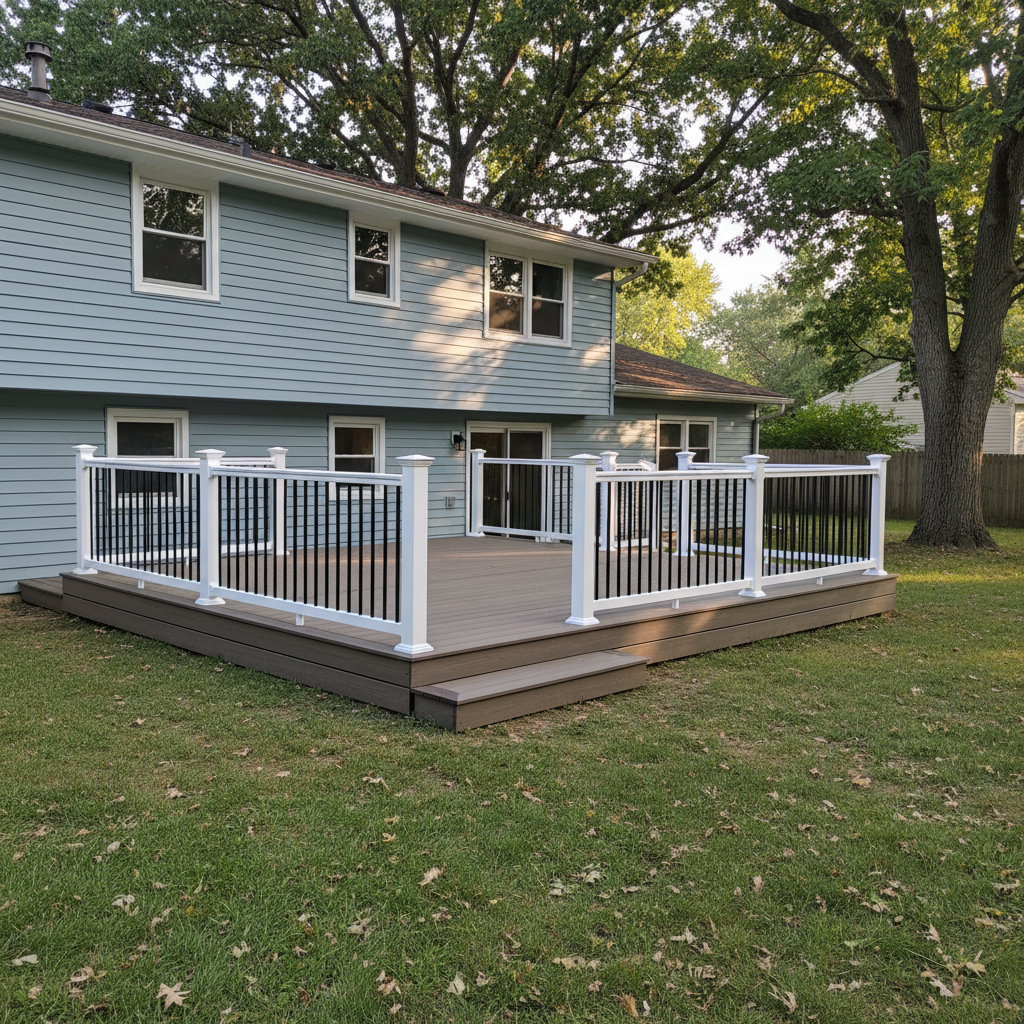
Most people shopping for a deck builder end up comparing three bids that all say roughly the same thing: quality materials, experienced crew, free estimate. That tells you nothing. The questions that actually separate a good deck from a bad one are boring, and they're about dirt, fasteners, and paperwork.
What the clay under your yard does to a deck
Saline County soil is mostly clay, and clay moves. It swells when it's wet, April and May especially, and it shrinks hard in a dry August. A footing that's only sunk 12 inches is sitting in the part of the soil that's doing all that moving. Over a few seasons that shows up as a deck that's slightly out of level, a post that's heaved an inch, railing posts that have started to lean. In this area footings generally need to go down around 24 inches to get below the active zone and onto soil that isn't shifting with the weather. Ask a builder how deep they're digging and what diameter the footing is. If the answer is vague, that's your answer.
A good builder will also tell you where water goes on your lot before they pour anything. Bryant doesn't have a lot of dramatic slope, which means drainage is often marginal to begin with, and a deck footing in the wrong spot can turn a damp corner of the yard into a standing-water problem after a heavy downpour.
Permits aren't optional, and a builder who skips them is telling you something
A deck attached to the house, with a few exceptions for small low platforms, needs a permit in Bryant and in unincorporated Saline County. That means a footing inspection before concrete goes in the hole, a framing inspection before the decking goes down, and a final once railing and stairs are in. A builder who tells you permits are a waste of time and money is either hoping to save you a fee at your expense, or doesn't want an inspector looking at work that won't pass. Either way, walk. If your structure ever gets sold, pulled up in a storm, or just inspected during a home sale, an unpermitted deck becomes your problem, not theirs.
HOAs are common in the newer subdivisions around Bryant. If you're in one, check the covenants before you fall in love with a design, especially for anything taller than a single story or any kind of screened structure.
Ask about the ledger board, not just the decking
Homeowners spend a lot of time picking composite color and almost no time asking how the deck attaches to the house, which is the part that actually fails. The ledger board bolted to your rim joist carries a huge share of the deck's weight. It needs to be lag-bolted or through-bolted, not nailed, and it needs flashing behind it so water doesn't track down between the ledger and the siding and rot the band joist. That rot is slow and invisible until a deck sags or a bolt pulls through soft wood. A builder should be able to describe this step without you prompting them.
Fasteners matter more than people think. Almost all treated lumber now is ACQ, which is more corrosive to metal than the old treatment was. Standard electro-galvanized screws and joist hangers will rust and lose strength within a few years in that lumber. You want hot-dip galvanized or stainless hardware, and a builder who knows this without being asked is a good sign.
Red flags worth walking away from
- A bid that's dramatically lower than the others with no explanation. Usually it's smaller footings, cheaper hardware, or no permit.
- Cash-only, no written contract, or a contract that doesn't list lumber species, footing depth, or fastener type.
- No proof of insurance. If a crew member gets hurt on your property and the company isn't insured, that liability can land on you.
- Reluctance to give you a start and finish date in writing. Weather here, especially the humid stretch in July and August, slows concrete cure and stain drying, so some flexibility is normal. A builder who won't commit to anything at all usually means they're juggling too many jobs.
- Pushback when you ask to see a current project in person. A builder confident in their framing will let you walk one.
Older neighborhood or new subdivision, the job is different
A lot of homes near downtown Bryant and over toward Benton are older, which means the existing framing a new deck has to tie into might not be up to current span tables, and a ledger attachment that looks fine from the outside sometimes needs sistered joists behind it. A builder working on a house like that should be checking the rim joist condition before quoting a number, not after.
Newer subdivisions built since the 2000s tend to have more consistent framing, but they often have tighter setbacks, and some sit on lots that were graded in a hurry, with fill dirt that compacts unevenly. Either way, a builder who's worked the area knows to ask for a survey or at least check setback lines before design, rather than after the footings are dug.
What a good conversation sounds like
You don't need to become a contractor to hire one well. You need a builder who answers specific questions with specific answers: footing depth, hardware type, who pulls the permit, how they handle a ledger on an older house, what happens if a hard rain hits mid-pour. If you get three bids that all sound like marketing and one that sounds like someone who's actually stood in the hole with a shovel, that's the one worth a second look. That's the approach behind Sterling Outdoor Living's deck work in Bryant and the surrounding towns, and it's the standard we'd want if we were the ones hiring.